
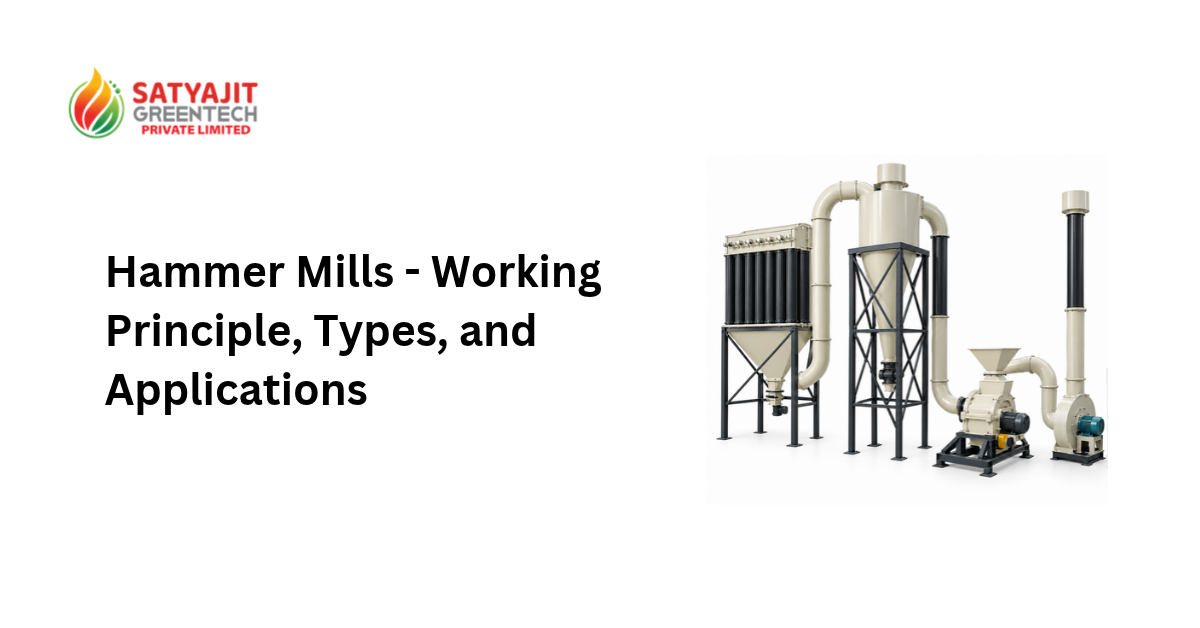
Hammer mills are widely used for reducing solid materials into smaller particles. They help prepare raw materials for further processing across industries such as biomass, food processing, chemicals and recycling. For businesses handling agricultural residues, the right equipment can support consistent material preparation and smoother production.
Understanding how hammer mills work, their types, applications and selection factors can help you make an informed investment. Experienced hammer mill manufacturers in India can guide you towards equipment suited to your processing requirements.
How Do Hammer Mills Work?
A hammer mill is a size reduction equipment that works due to high-speed rotating hammers impacting the material and breaking it. These hammers are mounted on a shaft located in a steel casing. When the shaft starts to rotate, the hammers hit the incoming material and crush it to smaller sizes.
The process includes three main stages:
- Feeding: Raw materials enter the crushing chamber through a feeding mechanism.
- Grinding: Rotating hammers repeatedly strike the material, reducing its size through impact. Collisions between particles may also contribute to the process.
- Screening and discharge: A screen separates particles according to the required size. Material that meets the specified size passes through the screen for collection or further processing.
The size of the final particle is defined by many factors, such as grid size, condition of the hammers, rotor speed and material properties.
What Are Main Types of Hammer Mills?
Various hammer mills are designed for processing particular types of materials. Understanding their features may help you to find the suitable hammer mill.
- Lump Breakers: These machines are designed to break down big lumps into smaller pieces or, in some cases, grind materials into a powder-like state. They can be used to process fragile materials, such as bonded chemical salts, lime chunks and clinker ash.
- Pneumatic Discharge Hammer Mills (PDHM): It is a hammer mill where material evacuation is provided by the air evacuation system. It can be used to process light materials, such as paper and biomass.
- Gravity Discharge Industrial Hammer Mills: This kind of hammer mill uses swinging hammers to crush particles due to the impact and collision of the particles. This equipment can be used for processing such materials as glass, ceramics and dry chemicals.
- Full Circle Screen Hammer Mills: These hammer mills have a grid that surrounds the crushing chamber at approximately 300 degrees. This design improves the process of particle evacuation and is appropriate for light materials, such as spices and grasses.
- Horizontal In-Feed Hammer Mills: Materials are supplied to these hammer mills using the horizontal feeding method. The design of the machine makes it convenient for heavy-duty processing of tough materials, including pallets and wood trim scraps.
The most suitable type of hammer mill depends on the material, required particle size and design of the equipment.
What Are Main Applications of Hammer Mills?
There are various industries which use hammer mills due to their ability to process various kinds of solid materials. Common applications include:
- Biomass processing: Grinding of agricultural residues, such as paddy straw, rice husk, mustard husk and cotton stalks for further processing.
- Food processing: Grinding of suitable materials such as grains, legumes, beans and nutshells.
- Chemical manufacturing: Reduction of solid materials to the required size.
- Pharmaceutical production: Processing of suitable raw materials into smaller particles.
- Recycling. Breaking of selected materials.
What Should You Take into Account While Purchasing a Hammer Mill?
When selecting a hammer mill, you should consider not only the cost of the device. Factors to take into account when selecting a hammer mill are listed below:
- Type of the material to be processed: Evaluate the hardness, fibre content, moisture content and size of the raw material.
- Required particle size: Find out the suitable screen configuration.
- Production capacity: The machine must be able to process the required quantity of materials.
- Power consumption: Compare the power requirements with your production schedule.
- Maintenance: Check the availability of spare parts and maintenance.
- System compatibility: Make sure the equipment can be integrated with your feeding and conveying systems.
Discussions with an experienced hammer mill or biomass pellet manufacturer in India can help you compare the specifications of the equipment and select a suitable hammer mill.
Conclusion
Hammer mills are helpful devices to reduce solid materials to smaller sizes in biomass processing and other industries. Efficiency of the equipment depends on its design, material and required particle size.
If you are looking for a suitable hammer mill for biomass processing, Satyajit Greentech Pvt Ltd can help you select the equipment that suits your production needs.