

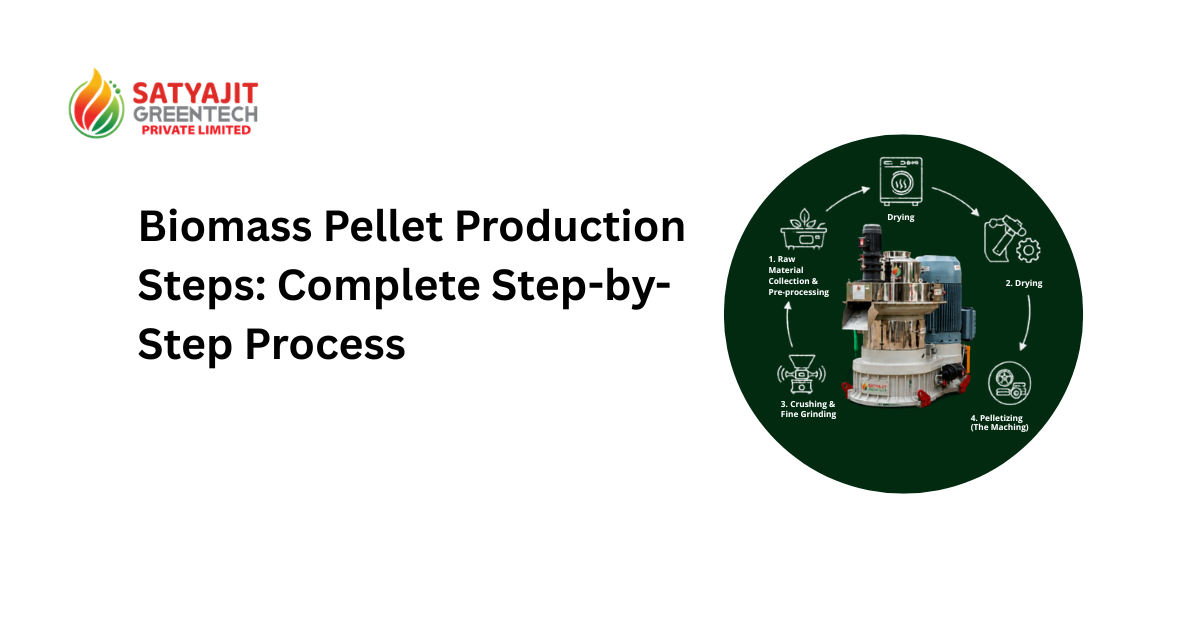
The production of biomass pellets has gained much significance as far as the renewable energy industry is concerned. Manufacturers are increasingly turning to clean fuels, governments wish to cut down on their carbon footprint and industries are looking for better profit margins.
Biomass pellets seem to satisfy all these needs and thus, it is no wonder that the market is witnessing their growing popularity. Nevertheless, making quality pellets requires following a certain process.
Indeed, the whole pellet production process affects the final characteristics, such as density and energy output of pellets. Knowing the process will help avoid possible mistakes and ensure high-quality products. With the help of the right Biomass Equipment, this goal becomes easier to achieve.
Stage One: Choosing and Cleaning Biomass Fuel
First, the choice of appropriate biomass material is essential for the quality of pellets. Wood chips, sawdust, rice husk, bagasse and agricultural residue are some of the most popular options. Besides, the material should be free of stones, metals, dust and other elements. Indeed, cleaning is important to prevent possible damage to the equipment and provide better binding during the next stages.
Stage Two: Grinding
Grinding reduces material to particles that should have a diameter of 3-10 mm. Uniform-sized particles are necessary for successful pelletizing as well as for proper binding.
Thus, it can be stated that proper selection and grinding of material using advanced technology will significantly contribute to the successful production process. Reliable Biomass Equipment will make the process effective and energy-efficient.
Stage Three: Drying
Moisture is another aspect that needs to be taken into account during the production process. High moisture contents can lead to brittle and unstable pellets.
In order to deal with this problem, drying is used. The moisture should be reduced to 8-15%. In this case, a pelletized product will have good binding capabilities.
There are two types of dryers: rotary drum and flash-type dryers that efficiently remove water from pellets. Thanks to drying, binding during the pelletization becomes possible.
Stage Four: Pelletizing
During pelletizing, dried material is sent to a pellet mill and pressed through the die at elevated temperatures and pressures. Lignin contained in biomass materials softens and functions as a natural binding agent, creating cylindrical pellets. The use of special machinery allows for the obtaining of pellets of perfect quality.
Stage Five: Cooling
The output from a pellet mill is hot and somewhat soft. To improve the properties of pellets, they should be cooled. This operation contributes to the hardening process as well as to the prevention of pellet spoilage due to moisture absorption and mould formation.
A counterflow cooler effectively performs this task and thus helps increase the lifetime of the pellets.
Stage Six: Screening and Elimination of Fines
At this stage, pellets pass through screening systems, which help eliminate dust and other broken and unformed particles.
Uniform pellets are only those that go further to the next stage, while other products are returned to the production process.
Well-organised systems make the process of recycling possible without significant losses of the raw material.
Stage Seven: Packaging and Storage
Finally, pellets are packaged for subsequent transportation. Special packages prevent damage to pellets during transportation.
Storage areas should be protected from moisture and air flow so that pellets can remain of high quality over a longer period of time.
Conclusion
As one can see, there are several steps to take in the process of biomass pellet manufacturing. All these processes are closely connected to each other, which is why each stage needs to be performed in accordance with specific requirements. At each stage, the help of reliable and efficient Biomass Equipment can be very beneficial.
If you are going to build a plant for the manufacture of pellets or simply wish to modernise your existing production, contact Satyajit Greentech Pvt Ltd today!